
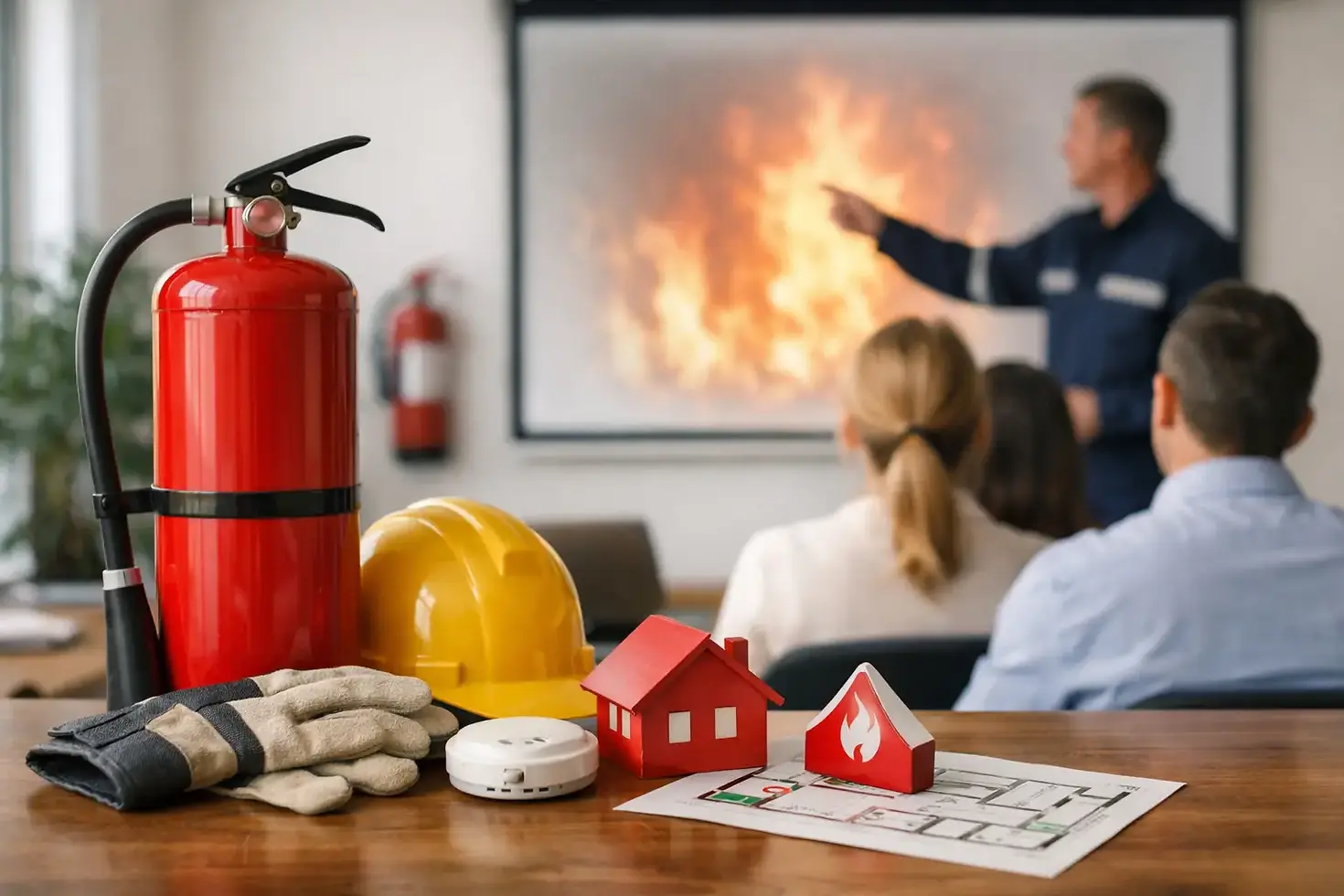
Fire Awareness Training Guide for UK Workplaces
- rodneyepstein
- Jul 19
- 6 min read
A fire alarm is not the time for people to work out which exit to use, whether they should collect belongings, or who is checking the toilets. A clear fire awareness training guide helps employers give every worker the knowledge to respond without hesitation. It also helps managers turn written fire procedures into actions people can recall under pressure.
For UK workplaces, fire training is not simply a box-ticking exercise. It supports safer evacuation, reduces the likelihood of unsafe behaviour and gives employees confidence in their role. The right approach will vary by premises, workforce and fire risk assessment, but the core aim stays the same: get everyone out safely and account for them.
What fire awareness training should achieve
Fire awareness training gives employees a practical understanding of fire risks and the site procedures designed to control them. New starters need this information as part of their induction, while existing staff need refresher training whenever circumstances change and at suitable intervals thereafter.
A useful programme should explain how fires start, what increases risk and how everyday decisions can prevent an incident. It should also make the emergency procedure unmistakably clear. Staff must know how to raise the alarm, leave by the nearest safe route, go to the assembly point and remain there until authorised to return.
Training should be proportionate. An office with a small team and straightforward escape routes needs a different level of detail from a warehouse, care setting, construction site or premises with sleeping accommodation. The fire risk assessment should inform the content, frequency and level of practical instruction.
Start with your fire risk assessment
Your fire risk assessment is the foundation of effective training. It identifies likely ignition sources, combustible materials, people at greater risk and the measures needed to protect everyone. It should also set out escape routes, alarm arrangements, emergency lighting, fire doors, signage and the responsibilities of nominated staff.
In England and Wales, the Regulatory Reform (Fire Safety) Order 2005 places duties on the responsible person to take general fire precautions and provide employees with suitable fire safety training. Scotland and Northern Ireland have their own fire safety legislation, but the practical expectation is similar: employers and those in control of premises must manage fire risk and prepare people for an emergency.
Do not rely on a generic course alone if it does not reflect your workplace. Online learning is an efficient way to give employees a consistent grounding, particularly across multiple locations or shift patterns. It should be supported by site-specific information, including local escape routes, the alarm sound, assembly arrangements and any personal emergency evacuation plans.
The essential topics in a fire awareness training guide
Every employee should understand the common conditions that allow a fire to develop. This includes ignition sources such as faulty electrical equipment, hot works, cooking equipment and smoking materials, alongside fuels such as waste, paper, packaging, flammable liquids and furnishings. Good housekeeping, safe storage and prompt reporting of defects are practical controls employees can apply every day.
Training should then cover the stages of an emergency. Employees need to know how to identify the alarm, how to report a fire if they discover one, and why they must never assume someone else has already acted. They should be clear that evacuation takes priority over investigating an incident or attempting to fight a fire.
Your course and local briefing should address these points:
what the fire alarm sounds like and how it is raised;
the nearest safe escape routes and alternative routes;
where to assemble and how roll calls are managed;
the importance of keeping fire doors closed and escape routes clear;
the rule against using lifts during a fire unless specifically designed and authorised for evacuation;
how to report hazards, damaged equipment or blocked exits; and
who has additional responsibilities, such as fire wardens or marshals.
Keep the language direct. Instructions such as “leave immediately by the nearest safe exit” are more memorable than lengthy policy wording. Where workers have limited English, literacy needs or accessibility requirements, provide information in a format they can understand and check that they have understood it.
Fire extinguishers: awareness is not automatic authorisation
Fire extinguisher training is often misunderstood. Employees should recognise that extinguishers are for a very limited, early-stage situation and only where they have been trained, it is safe to act and they have a clear escape route behind them. No one should feel expected to tackle a fire.
A short awareness course can explain the different types of extinguisher and why using the wrong one can be dangerous. However, awareness does not make someone competent to use equipment in a real incident. Staff who are designated to use extinguishers need suitable practical instruction and should understand the limits of their role.
This distinction matters in high-risk settings. In a kitchen, workshop or industrial site, there may be specific hazards that require additional procedures. In a care environment, the priority may be phased or assisted evacuation rather than immediate full evacuation. Training must reflect the plan, not a one-size-fits-all assumption.
Give fire wardens clear, realistic responsibilities
Fire wardens, sometimes called fire marshals, support the responsible person by helping to maintain fire safety arrangements. Their exact duties depend on the workplace plan and the risks identified. They may carry out routine checks, report concerns, help direct people during an evacuation and assist with the roll call process.
They should not be asked to put themselves at risk. Searching an area, for example, must only be done where it is safe, within agreed procedures and without delaying evacuation. Fire wardens need more detailed training than general employees, as well as enough time and authority to carry out their duties properly.
Organisations should also consider cover. A single trained warden who only works weekdays may leave significant gaps during holidays, sickness, evenings or night shifts. The number of wardens should reflect the size and layout of the premises, the number of occupants and the needs of visitors or people who may require assistance.
Make online learning part of a workable training plan
Online fire awareness training is especially useful for organisations that need consistent delivery without taking whole teams away from work at once. Learners can complete modules at a suitable time, revisit key information and receive evidence of completion for training records. For individual learners, it can also provide a convenient way to build recognised health and safety knowledge around work and other commitments.
For best results, combine online learning with a short local briefing. A manager can show new starters the alarm call point, exits, refuge areas where applicable and assembly point. This takes little time but closes the gap between general knowledge and the reality of a particular building.
Training Via Technology provides accessible online courses designed to help learners complete professional training quickly and easily. When selecting any course, check that its level, content and certification suit your role, sector and employer requirements. Accreditation and clear completion records can give organisations greater confidence when managing workforce learning.
Test procedures through drills and review
A fire drill tests the procedure, not just the people. It can reveal problems that are easy to miss on paper, such as an exit that is routinely obstructed, a noisy work area where the alarm cannot be heard or an assembly point that is too close to emergency vehicle access.
After each drill, record what happened and act on the findings. Consider how long evacuation took, whether visitors were accounted for, whether wardens understood their roles and whether anyone used an unsafe route. Avoid treating a fast evacuation time as the only measure of success. A calm, controlled evacuation with everyone accounted for is more valuable than speed achieved through confusion.
Review training whenever there is a significant change. This may include alterations to the building, new equipment, changed shift patterns, new occupants, a fire incident or a near miss. Refresher learning should also be planned so knowledge does not fade between inductions and drills.
Keep evidence that supports compliance
Training records should show who completed learning, when it was completed, the topics covered and any additional site-specific briefing provided. Keep records of drills, fire warden training, equipment checks and actions taken after reviews. These documents help demonstrate that fire safety is being actively managed rather than left to a policy on a shared drive.
Most importantly, make fire awareness part of normal working practice. When staff know that a wedged-open fire door, overloaded extension lead or blocked corridor should be reported immediately, training has moved beyond certification. That everyday awareness is what gives people the best chance of responding safely when it matters.



Comments